
Author

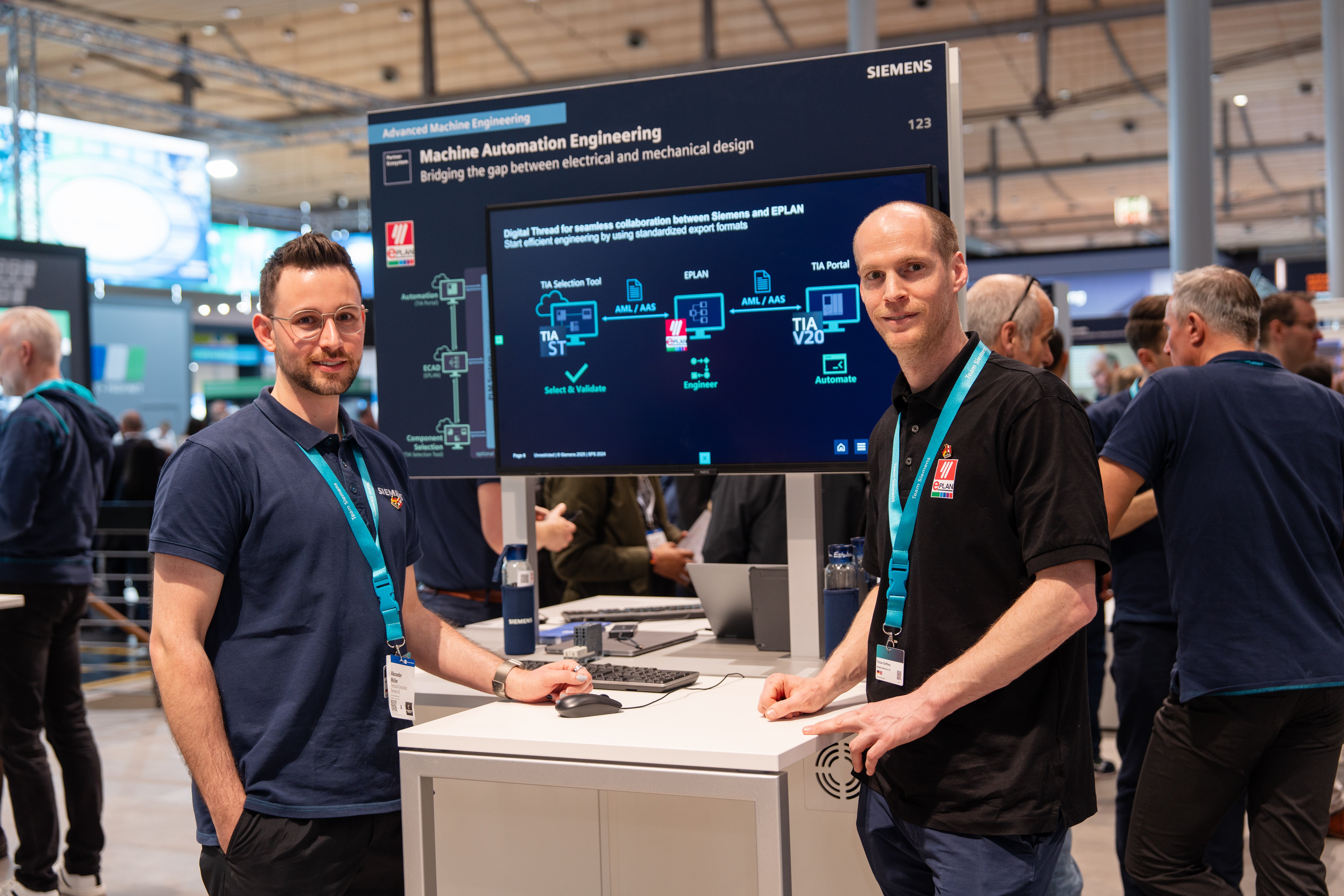
For more than 40 years, Eplan has been a leader in software for electrical engineering and control cabinet design, driving standardisation and automation in the industry. Eplan collaborates with partners to accelerate the development of integrated solutions. Among other things, Eplan plays an important part in Siemens' engineering ecosystem and over the past few years, both companies have been working on seamlessly integrating multiple systems. This includes the automated interaction between the product lifecycle management software "Teamcenter® X" and Siemens' TIA Selection Tool configurator with the Eplan Platform. The goal is to make the required engineering information readily available to both systems, thereby significantly simplifying collaboration across different disciplines. Once entered or generated, information and data are made available electronically and automatically to all other systems.
Eplan builds smart interfaces to connect with other systems and tools, accelerating electrical engineering workflows while reducing errors across the entire process. This represents a true paradigm shift, especially when design changes affect multiple disciplines. But this isn't limited to "traditional" solutions. Eplan is also exploring how artificial intelligence can effectively take over tasks in cross-company processes.
"Siemens approached us last year and asked if we would like to participate in one of their projects," explains Julian Rahm, Head of Research & Prototyping, regarding a recent collaboration with the partner company. "The goal was to develop an agent system that improves data exchange between their TIA Portal and our Eplan Electric P8. This was only the starting point."
Using Artificial Intelligence at Eplan
The starting Point – the beginnings of the "topic of artificial intelligence at Eplan" date back to 2018. This is when the AIDA department, Artificial Intelligence and Data Analytics, was established. Here, the team focused on concepts, analyses, and validations of data, machine learning, and the application of AI models in the context of engineering solutions for automation technology.
The goal was, and still is, to provide electrical engineers with sustainable, and in this case, AI-based solutions. These solutions should be tailored to specific requirements while simultaneously preserving the creativity, expertise, and problem-solving skills that are essential for engineers. Developing such technologies is no small feat – it requires in-depth expertise and a precise understanding of the environments in which customers operate.
But that doesn't stop Eplan from looking ahead to the future of AI in engineering. “In the long term, the goal is to automate repetitive tasks,” explains CEO Sebastian Seitz at the expert panels he regularly attends. “A key prerequisite for the successful use of AI technology is the availability of high-quality data.”
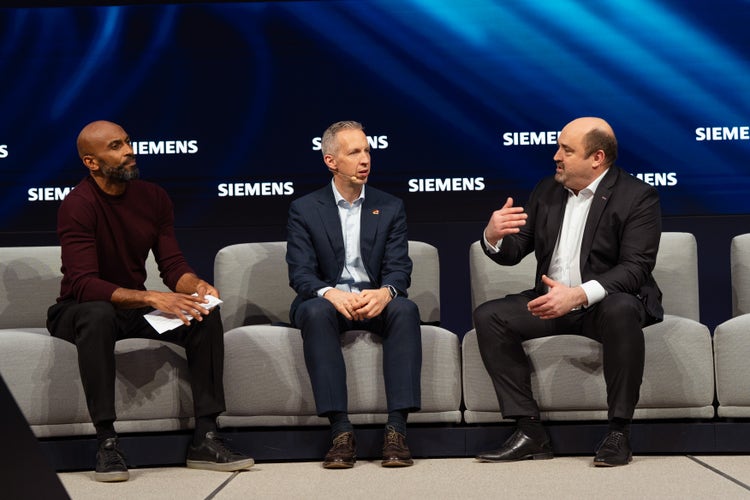
Eplan CEO Sebastian Seitz (right) and Rainer Brehm, CEO of Factory Automation at Siemens (centre), during a panel discussion on artificial intelligence at Hannover Messe 2025.
Eplan and Siemens collaboration on artificial intelligence
Eplan and Siemens have now developed a joint solution to integrate electrical and automation technology with industrial AI agents. Specifically, this involves a comprehensive suite of different agents. Their collaboration aims to solve a long-standing challenge: the synchronisation of project updates and information between electrical engineering (Eplan) and automation technology (Siemens' TIA Portal). The goal is to enable teams to work in a coordinated manner and therefore more efficiently. Siemens contributes its extensive experience in integrating industrial software solutions and implementing complex engineering workflows.
To achieve this, Eplan experts, such as Julian Rahm, shared their engineering know-how with specialists from Siemens. Together, the teams developed a use case for a demonstration plant and the project was fully implemented.
The engineers focused on a specific scenario: Users of the Siemens TIA Portal receive a notification that the monitoring agent of the Product Lifecycle Management System has detected that an electrical component, such as a Siemens motor protection switch, is available in a more modern version. After user approval, the Siemens Engineering Copilot TIA connects to a so-called Orchestrator agent; this is a higher-level AI that coordinates the actions of the various agents within the system. This Orchestrator agent then coordinates the solution using the necessary agents and automatically updates the Eplan circuit diagram and the mounting plate layout.
“For designers, this means they no longer have to manually type anything in and swap components,” explains data expert Rahm. “Instead, they can say, ‘Hey Copilot, please change the following component from article A to article B.’ The agent then checks the individual connected systems and eventually finds the EPLAN data. It then asks the designer if this data should also be updated.”
The cycle is complete when the change in the circuit diagram is made, and the necessary adjustments are also made in the Siemens TIA Portal by the agent. As the Orchestrator agent monitors and controls the entire process, no information is lost and change steps cannot be accidentally omitted.
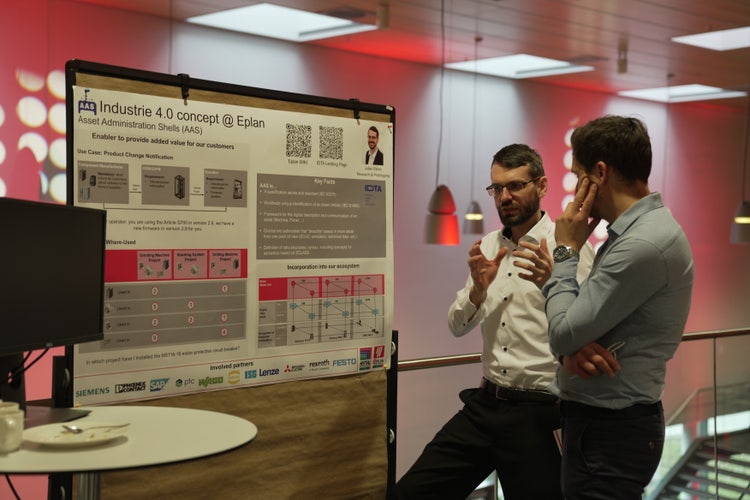
Julian Rahm, Head of Research & Prototyping at Eplan (in the picture on the left).
Data is the key to making AI systems work.
The described use case isn't a difficult task, but it is a typical and time-consuming one. To automate its completion, Eplan had to provide the appropriate data. Rahm: “We looked at what needed to happen on our side and what needed to happen on Siemens' side, and how that all interacted; what kind of data needed to be exchanged – and how exactly?”
The advantage was that Eplan, with its data concept also used for the Asset Administration Shell (AAS), already had a suitable back end that clearly describes components. "When software systems interact, it's always about how individual points of information can be identified. The Asset Administration Shell concept does exactly that. Every component is uniformly identifiable. This makes it clear which ones would need to be replaced. A concept adapted by Siemens for their systems accordingly at the relevant interfaces. AI then builds on this foundation by translating commands into precise adjustments. Each individual input is analysed and broken down so the system understands exactly what actions to take.
Basic groundwork is crucial for AI systems.
The link now established between TIA Portal and Eplan could also serve as a blueprint for future projects. So far, the system is a prototype – similar to a concept car in the automotive industry. Whether and when it will go into series production is currently undecided. Tests and safety measures are still lacking, but these are essential for Eplan. The company aligns its actions with the needs of its customers and prospects. These needs are to be met as effectively as possible by creating an intelligent, user-friendly Eplan engineering environment. The use of artificial intelligence does not change this objective. The collaboration with Siemens offers the advantage of access to proven AI components and established industry standards, which facilitate the transition from feasibility studies to scalable solutions. The Eplan vision fits perfectly into a larger picture that Siemens calls 'Advanced Machine Engineering' – at its core is a continuous data flow from proposal planning to service, supported by AI-driven engineering processes.
Find out more about Eplan's part in AI-Driven Industrial Automation.
Comments