

Author

Many programmers express concern that AI could make their profession obsolete. Will you still need programmers in the future, or rather employees who can prompt?
We still need employees who can program – and ask the right questions! The use of AI undoubtedly offers great potential in software development. Large language models can learn many languages, including programming languages. Some models even already possess good programming skills. The real problem, however, isn't programming itself, but asking the right questions and accurately describing the task. The art lies in specifying requirements in such a way that they are programmable – and so far, only a human can do that.
How is AI changing the way product development works, and where can it already benefit from AI?
We're still at the beginning – but there are already initial use cases where AI supports certain workflows. The benefits are particularly evident in repetitive tasks. If we use AI in a way that fosters creativity and provides relevant information at the right time, we're on the cusp of a revolution. Today, however, all of this is only just beginning to take shape – in electrical engineering, we're far from having achieved a fully AI-supported workflow. First, we need to determine where we can start. Here again, a precise description of the requirements is crucial. And ultimately, as before, what matters is the added value for the customer.
At the Hannover Messe 2025, initial approaches based on Microsoft's copilot were already presented – where is the added value here?
One important area is the provision of specific expertise that can be accessed directly via the copilot – for example, regarding relevant standards. AI also enables quick answers to even seemingly trivial technical questions – though these answers are quantitatively and qualitatively dependent on the available input. Furthermore, we are working with Microsoft to specifically integrate AI into the design process: For example, generative AI allows us to suggest layout options for mounting plates to electrical engineers. A third aspect, alongside knowledge transfer and process acceleration, is automated quality assurance – a central element of our work. The goal is not only to become faster, but above all to achieve better results.
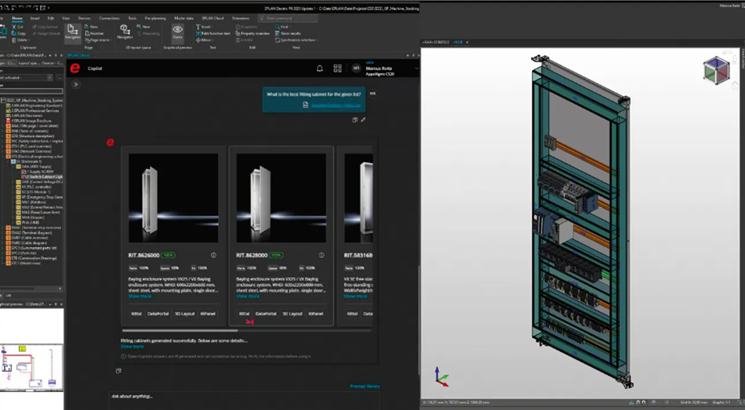
Regarding the layout suggestions for the mounting plate – is the underlying principle ultimately machine learning based on known layouts, or can generative AI do more?
It can do more, and this isn't machine learning with classic image recognition. While the latter would be possible in principle, it wouldn't take into account the individual working methods of each switchgear and control system manufacturer. Generative AI can do significantly more – however, it does need to be given some basic rules. To derive such rules, existing systems, especially in the 3D layout area, can be used as models. This allows us to consider each switchgear manufacturer's own logic and individual experience – and that's precisely our goal. If we can effectively map this process in our field using AI, we'll achieve real efficiency gains.
Can the potential be quantified?
Rule-based processes are already common in circuit diagram creation. Our platform allows for almost complete automation of this. Predefined rules and conditions can significantly reduce design time. One of our customers reported savings of 94 to 96 percent.
Can AI actually deliver ‘intelligent’ solutions – in the sense of ‘strong’ AI?
Let me begin by quoting from a lecture on AI that I recently attended. It stated: "Intelligence is the autonomous solving of problems. AI, however, doesn't have its own problems – humans have to describe them so that AI can solve them." I find this a fascinating perspective, and it confirms that the real challenge lies in asking the right questions. Our goal is to reach the point where electrical design can be carried out autonomously, automatically, and based on a sound description. AI will help accelerate this process.
You can read the full interview (German) in KEM – Konstruktion I Automation .
For more information on the future of Eplan and AI, see below.

Comments